Colorado Teen Driver License: Requirements from Permit to Card
Getting a Colorado teen driver license takes more than passing a test. The required course, permit age, practice period, driving test, and passenger limits depend on the teen’s age and stage. Here’s how the steps fit together, what to prepare, and which details to confirm before scheduling a visit or test.
How the Colorado teen licensing path works
Colorado uses a graduated licensing process for drivers under 18. A teen generally starts with an instruction permit, practices with a qualified adult, passes a driving skills test, and applies for a minor driver license. Each stage has its own eligibility rules. Completing one step does not automatically complete the next.
The permit’s minimum age depends on the teen’s age and education. Before a minor can get a license, they generally must hold the permit for a required period, complete supervised practice, and pass a skills test. After getting the license, passenger, nighttime driving, and phone restrictions apply.
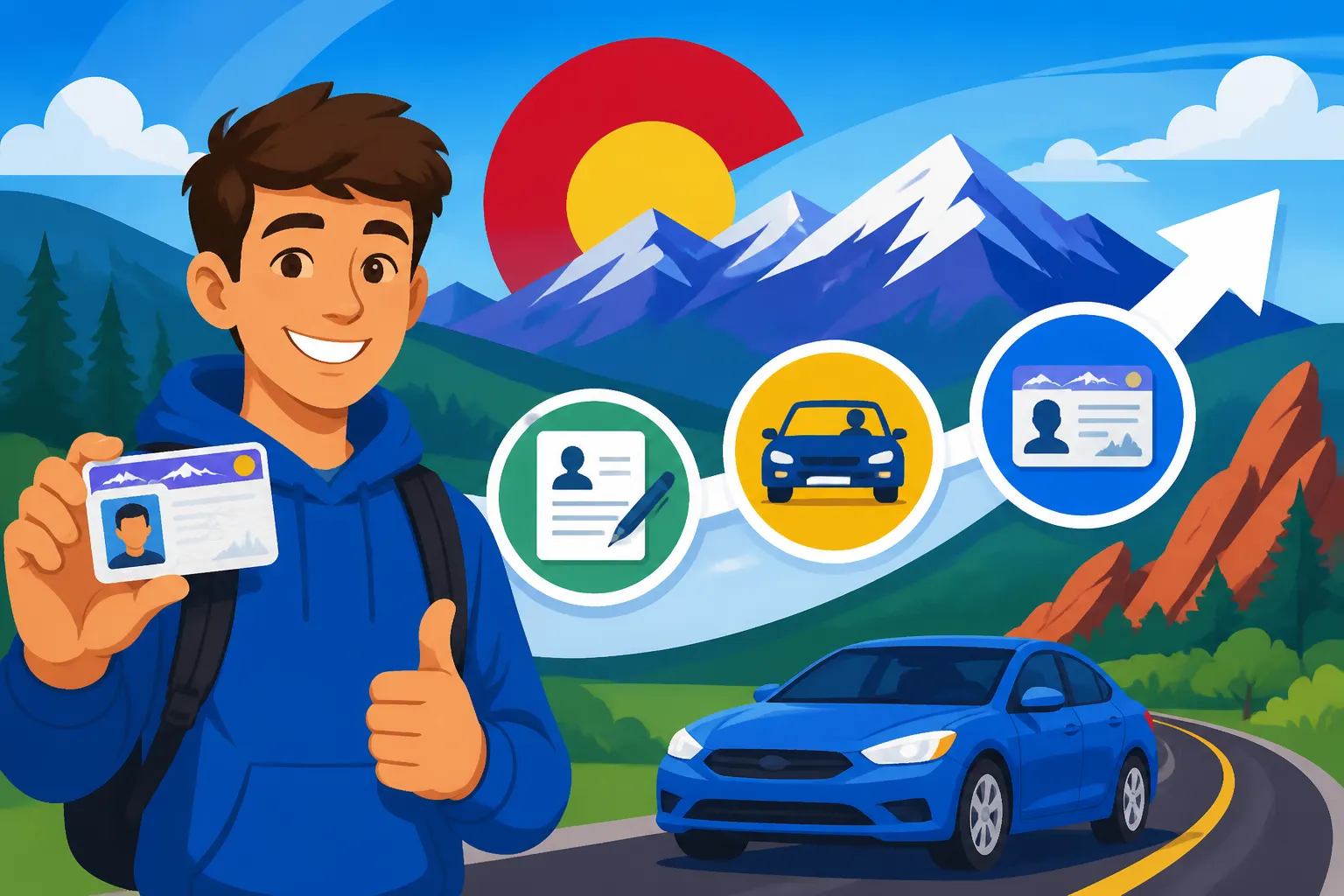
Here’s the broad sequence:
| Stage | What the teen generally needs to do |
|---|---|
| Prepare for a permit | Meet the age-based education requirement, study the driver manual, and gather required documents |
| Apply for a permit | Complete the application and knowledge test through the Colorado Division of Motor Vehicles process |
| Practice | Drive with a qualified supervising driver and keep the required practice record |
| Qualify for a license | Meet the permit-holding and training requirements that apply to the teen’s age |
| Pass a skills test | Take the road test through an approved driving school or other authorized tester |
| Apply for a minor license | Complete the application process, meet parent or guardian requirements, and have a license photo taken |
| Follow GDL restrictions | Observe limits on passengers, nighttime driving, and wireless-device use while under 18 |
The exact route depends partly on age. For example, a teen who qualifies for a permit at 15 may have a different education requirement from one who waits until 16. Training requirements can also depend on the age when the teen applies for a license. Check current requirements with the Colorado Division of Motor Vehicles before paying for a course or booking a test.
For a complete overview of how permit, practice, and licensing stages connect, see The Step-by-Step Path to a Colorado Teen’s Driver’s License.
Permit age, education, and application
Check which education requirement applies
Colorado’s permit rules distinguish between younger teens and older applicants. In general, a teen seeking a permit at 15 needs to complete an approved driver education course. A teen applying from age 15½ to under 16 generally needs to complete an approved driver awareness course. At 16 or older, a teen can generally apply for an instruction permit without first completing one of those courses.
These are age thresholds, not suggestions. Confirm how the state calculates the relevant age and which course it accepts before enrolling. A course marketed for teen drivers may not meet Colorado’s specific requirement. If you are considering an online provider such as I Drive Safely, verify that the particular course is currently approved for the teen’s Colorado permit pathway. Approval for one state or course category does not necessarily mean approval for another.
Keep proof of course completion. The DMV may need to verify that the requirement is satisfied, and having the completion record available can help if records do not appear as expected.
Study before taking the knowledge test
The permit knowledge test covers driving laws, signs, safe-driving practices, and other subjects in the Colorado driver handbook. Reading the handbook is more useful than relying only on a practice quiz: the handbook explains the rules behind the correct answers, including situations a new driver may not have seen on the road.
A practical study plan is to read a section, review its signs and rules, and then answer practice questions on that material. Pay particular attention to right-of-way, intersections, speed management, lane changes, following distance, impaired driving, and sharing the road. If a practice question conflicts with the current handbook, use the official handbook and verify any confusing rule with the state.
For other study approaches, see Colorado Driver Handbook Study Resources and Online Practice Tests. If a teen needs language support, Spanish Driver Manual and Study Resources for Knowledge Testing may help identify appropriate study materials.
Gather documents and parent information
A minor’s application involves more than proof of identity. The teen may need documents that establish identity, lawful presence where applicable, a Social Security number or the required information about it, and Colorado residency. The exact list depends on the teen’s circumstances and the credential being requested. Documents may need to be original or certified copies, and names should match across records or be supported by acceptable name-change documents.
A parent or guardian may need to provide consent or sign an affidavit of liability. Do not assume that a photocopy, digital image, or expired document will be accepted. Use the current state checklist to confirm what to bring and whether the parent or guardian must attend.
For a more detailed preparation list, see Documents Required for a Colorado Teen Learner’s Permit, Colorado Minor Permit Appointment: Required Forms and Parent Rules, and Colorado Driver License and State ID Document Requirements. These are useful for catching document gaps before the appointment rather than discovering them at the counter.
Applying for and using an instruction permit
Once the teen meets the age and education rules, they can complete the permit application and knowledge-test process. The state’s driver licensing office handles permits and driver licenses; county motor vehicle offices generally handle vehicle registration and plates, not teen driver licensing. Choose the correct service and location before making an appointment. The state’s office locator is the place to confirm current locations and hours.
The permit application may require a vision screening, a photo, identity documents, and parent or guardian participation. Testing and appointment procedures can change, so check the current instructions before traveling. Do not rely on an old notice or a friend’s experience as a complete checklist.
Permit driving is supervised
A teen with an instruction permit cannot drive alone. Colorado generally requires a qualified driver who is at least 21 to sit in the front passenger seat and supervise. The supervising adult must be properly licensed for the vehicle being driven and should be alert enough to guide the teen. Confirm the current supervision rules before practice, especially if the adult’s license has restrictions or the vehicle requires a special credential.
Good supervision is active, not passive. The adult should choose practice routes appropriate to the teen’s ability, explain hazards before they arise, and give clear feedback after a maneuver. Early sessions are often best on quiet streets and in familiar areas. More challenging situations—busy intersections, highway merges, poor weather, and night driving—can be introduced as skills improve.
The teen should carry the permit whenever driving and follow all permit restrictions. A parent’s permission does not make solo driving legal, and a short trip around the neighborhood is still driving without the required supervision.
Plan practice across different conditions
Practice should build from basic vehicle control to decisions in traffic. Useful skills include starting and stopping smoothly, turning, changing lanes, scanning intersections, maintaining a safe following distance, parking, and responding calmly to unexpected events. The supervising adult can keep a written record of the date, conditions, and skills practiced, even before completing the formal log.
Night practice deserves its own attention. Glare, reduced visibility, and judging distance in the dark can make familiar roads feel different. Practice only when the teen is rested and the supervising adult can remain attentive. Do not leave all nighttime practice until the end of the permit period.
Practice hours and required training
A Colorado teen applying for a minor license generally needs to complete a supervised driving log. The commonly required total is 50 hours, including 10 hours at night. The parent or guardian may need to certify that the practice has been completed. Check the current state form and instructions because the required way to record or submit hours can change.
The log is not just paperwork. It helps families see whether the teen has driven in enough settings to be ready for independent driving. A teen who has completed 50 hours mostly on the same quiet route may still need more experience with unfamiliar roads, heavy traffic, parking, adverse weather, and nighttime conditions.
A simple log can record:
- Date and approximate duration of each drive
- Whether the drive was daytime or nighttime
- Road and traffic conditions
- Skills practiced
- A note about what needs more work
Record drives soon after they happen. Reconstructing months of practice from memory can lead to mistakes, and a parent’s certification should reflect actual practice rather than an estimate.
Training may depend on age at licensing
The permit education rule and the behind-the-wheel training rule are related but are not the same thing. A teen may need one course to qualify for a permit and additional driver training to qualify for a license, depending on age. In particular, Colorado has additional training requirements for some younger applicants, including behind-the-wheel instruction in certain circumstances. The required amount and any permitted alternative can depend on age and whether an approved driving school is available within the relevant distance.
Because this part of the rules is easy to misread, confirm the teen’s exact situation with the DMV and an approved provider. Ask whether the teen needs classroom education, driver awareness, behind-the-wheel instruction, or a specific alternative, and whether completion must be documented before the license appointment.
Do not treat a general online course certificate as proof of behind-the-wheel training. Classroom and awareness courses teach concepts; supervised practice and behind-the-wheel instruction develop vehicle-control skills. They serve different purposes.
If the family is comparing providers, verify that a school is approved for the service needed and ask how it reports completion. Finding Approved Driving Schools for Road Testing Across Colorado can help distinguish approved providers from places that offer unrelated services. For the practice log, see Tracking and Submitting the 50-Hour Driving Log for Colorado Teens.
Passing the driving skills test and getting the card
A teen must pass the required driving skills test before qualifying for a license. Colorado’s state driver licensing offices generally do not conduct road tests; tests are arranged through authorized third-party driving schools or testers. That means a state office appointment and a road-test booking are separate tasks.
Before scheduling, check that the teen has held the permit for the required period, completed required training, and is ready to test. A test provider may have its own vehicle and appointment procedures, but the state’s eligibility rules still apply. Confirm whether the test vehicle must be provided by the teen or school, what documents the teen must bring, and what happens if weather or vehicle problems interrupt the test.
The test typically assesses whether the teen can operate the vehicle safely and make sound decisions in traffic. Preparation should cover observation, signaling, turns, lane position, speed control, stops, backing, and responding to the examiner’s directions. A teen should practice in the same type of vehicle that will be used for the test when possible. The vehicle must be legally registered and insured, and its safety equipment should work.
A failed test does not mean the teen must start the entire licensing process over. The tester can explain areas needing improvement, and the family can check the current retest rules and scheduling options before booking again. Avoid scheduling another test immediately just to preserve momentum if the teen still needs targeted practice.
After passing, the teen must complete the state’s license application process. A road-test pass does not itself authorize unsupervised driving before the license is issued or otherwise made valid under current rules. The state may require an in-person visit, application verification, a photo, and payment of applicable charges. Costs and accepted payment methods can change, so check current state information before the appointment.
Allow time for card delivery if the teen receives a temporary document while the physical card is being produced. Keep any temporary credential and follow its conditions. If the card does not arrive when expected, use official state instructions to check its status rather than assuming that a test result serves as a permanent license.
For appointment planning, see Booking Your Teen’s Colorado License Test Weeks Ahead and Visiting a Colorado DMV Office: Appointments and Rules. For a broader discussion of documents for the licensing visit, see What to Bring to an In-Person Colorado Driver License Office.
Restrictions after a teen gets a license
A minor license gives a teen more independence, but it is still subject to Colorado’s graduated driver licensing restrictions. The limits are designed to reduce distractions and risk during the early months of driving. Parents should review them with the teen before the first solo trip, not after a warning or citation.
Passenger limits
Colorado generally restricts passengers under 21 during the early period after a driver under 18 receives a license. The rules commonly prohibit passengers under 21 during the first six months, with an exception for immediate family members, and then limit the number of younger passengers during the next six months. A qualified adult in the vehicle may also affect whether an exception applies.
The precise definition of immediate family and the conditions for each exception matter. Do not assume that a cousin, friend, or teammate qualifies. Check the current statute or DMV guidance before relying on an exception. A family should also consider whether adding even an allowed passenger is wise: new drivers may be more distracted when friends are present.
For a practical explanation of how these limits work, see Colorado Teen Driving Curfew and Passenger Limits Explained.
Nighttime driving and curfew
A teen driver is generally restricted from driving during certain late-night hours during the first year of licensure, with exceptions provided by law. Exceptions may relate to a qualified adult in the vehicle, work, school, or an emergency, but the teen and parent should confirm the precise conditions before planning a trip. A job schedule or school activity does not automatically remove every restriction.
Parents can make the rule easier to follow by planning rides in advance. If a shift or activity ends late, arrange transportation before the teen leaves home rather than asking the teen to decide at the end of the evening whether an exception applies.
Phone use and other distractions
Colorado restricts wireless-device use by drivers under 18, subject to limited legal exceptions such as an emergency. A teen should not hold a phone to read messages, make routine calls, or use an app while driving. Setting navigation and music before moving, enabling focus settings, and putting the phone out of reach can reduce temptation. A passenger should not be asked to handle a phone in a way that distracts the driver.
Passenger rules and phone restrictions do not replace basic safety practices. Seat belts should be worn by everyone, speed limits must be followed, and driving should stop when fatigue, distress, or unsafe weather makes continuing a poor choice. Parents can reinforce these habits by modeling them whenever they drive.
A practical checklist and common setbacks
Most licensing delays come from a missed eligibility condition, incomplete documents, a course that does not satisfy the right requirement, or a mismatch between test and appointment scheduling. Use this sequence to reduce avoidable repeat trips.
- Confirm the teen’s age-based path. Identify the permit education rule and any additional training required for the license.
- Choose an approved course or provider. Verify that the specific course or service meets Colorado requirements before enrolling.
- Study the current handbook. Use the state’s material as the main source for test preparation and road rules.
- Gather documents early. Check identity, residency, Social Security information, and parent or guardian requirements against the current state checklist.
- Complete the permit process. Follow the state’s instructions for application, testing, vision screening, appointment, and payment.
- Practice consistently. Keep the permit with the teen while driving, use a qualified supervisor, and record required hours accurately.
- Verify training and holding-period requirements. Do this before booking a road test, not on the day of the test.
- Book an authorized skills test. Confirm the provider’s vehicle, documents, and cancellation requirements.
- Prepare for the license application. Check whether the teen needs an office visit and whether a parent or guardian must attend.
- Review restrictions together. Make sure the teen understands passenger, nighttime, and phone rules before driving alone.
Common problems to avoid
Enrolling in the wrong course. Course names can sound similar even when they meet different requirements. Confirm the exact course category and approval before paying.
Assuming practice hours replace training. The supervised driving log and any required formal instruction are separate requirements. Completing one may not satisfy the other.
Leaving the log until the end. A log completed from memory is less reliable. Record drives as they happen and make sure the parent or guardian understands any certification requirement.
Booking a test before checking eligibility. A test appointment may be available even if the teen has not completed the required permit period or training. Confirm eligibility first.
Going to a county vehicle office for a license service. Colorado separates driver licensing from many vehicle registration services. Check that the appointment is with a state driver licensing office.
Bringing incomplete or unsuitable documents. A document may be valid in everyday life but not acceptable for a particular application. Check whether originals or certified copies are needed and whether name differences require supporting records.
Treating a pass as immediate permission to drive alone. Follow the state’s instructions about when the license becomes valid and what temporary document, if any, the teen must carry.
Forgetting the restrictions after the card arrives. The license card does not end the graduated licensing period. Passenger, nighttime, and phone rules remain important until they no longer apply.
If the teen has an unusual situation—such as a name mismatch, a course completed outside Colorado, a transfer from another state, or difficulty meeting a document requirement—ask the DMV what evidence it accepts before making the appointment. For minors, Affidavit of Liability Rules When Minor Drivers Apply in Colorado may also be relevant. If the teen is approaching age 18, confirm how that timing affects the required steps rather than assuming that every minor requirement disappears automatically.
Frequently Asked Questions
How old does a teen have to be to get a Colorado instruction permit?
The minimum age depends on the education requirement. Teens may qualify at 15 after completing approved driver education, at 15½ after completing an approved driver awareness course, or at 16 without those courses as a permit prerequisite. Confirm current eligibility with the Colorado Division of Motor Vehicles.
How many practice hours are generally required before a minor license?
A minor generally needs to document 50 supervised driving hours, including 10 hours at night. Check the current state form and instructions for how the hours must be recorded and certified.
Does the Colorado DMV give the teen road test?
Colorado state driver licensing offices generally do not conduct road tests. Teens usually arrange the skills test with an authorized third-party provider, then complete the license application process with the state.
Can a teen drive friends after getting a license?
Not without checking the graduated licensing passenger rules. Restrictions apply during the early period after licensure, and exceptions are limited. Review the current rules before carrying passengers under 21.
What happens if the teen turns 18 during the process?
Age can affect which requirements apply, and timing may matter. Ask the Colorado Division of Motor Vehicles how the teen’s age and current credential affect the remaining steps before changing plans or assuming a requirement no longer applies.
Disclaimer
This article is for general informational purposes only and does not constitute professional advice. Laws, prices and regulations vary by location and change over time. Consult a qualified professional for guidance on your specific situation. Colorado Driver Guide is not a government agency and is not affiliated with any state motor vehicle department.